

Table-Top Roleplaying games collection
On this page you can find all the RPG systems that are available in the DrakenKelder. The books and material that is available can be found on the shelf in the corner next to the desk in DK. See the image for the specific shelf.

Available systems:
- D&D
- Pathfinder
- Warhammer 40K: Wrath and Glory
- Avatar Legends
- Doctor Who 2e
- Shadowrun sixth world
- Blood & Doom
- Vampire the masquerade
- Starwars: Edge of the empire
- Starfinder
- Cyberpunk red
- Daggerheart
- Mage the ascension
- Werewolf the apocalypse 2e
- Call of cthulhu
- Fanaat RPG: Kerkers en Draken
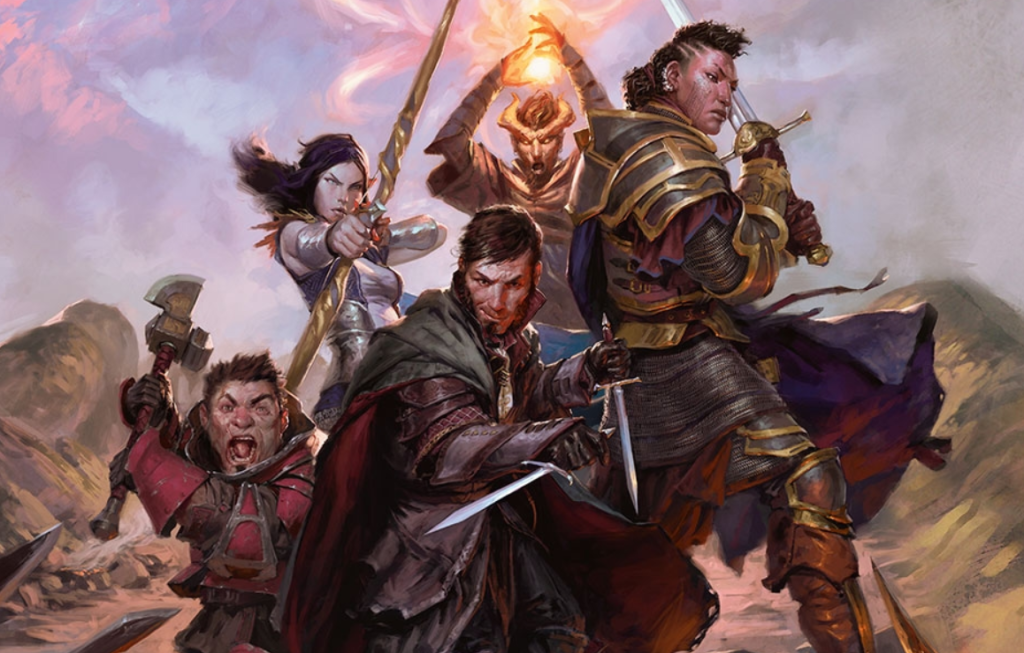
Dungeons and dragons
Dungeons & Dragons (D&D) is a cooperative storytelling game where players create characters and go on adventures in a fantasy world. One player takes on the role of the Dungeon Master (DM), who describes the environment, controls creatures, and presents challenges. The other players each control a hero character, such as a wizard, fighter, or rogue. Together, the group creates a shared story by exploring locations, interacting with characters, solving problems, and making decisions that influence the outcome.
When a character attempts something uncertain, such as attacking an enemy or persuading someone, the player typically rolls a 20-sided die (d20) and adds bonuses based on their character’s abilities and skills. The Dungeon Master then determines whether the action succeeds. What makes D&D distinct is that there is no fixed script; the story evolves based on player choices, combining structured rules with improvisation and creativity.
D&D 5e
D&D 5th Edition, released in 2014, is the most widely played version of the game. It simplifies many of the mechanics found in earlier editions, making it easier for new players to learn. One of its defining features is the advantage and disadvantage system, which replaces many smaller modifiers with a simpler approach. The edition balances roleplaying and combat, and emphasizes flexibility and storytelling, making it accessible to a broad range of players.
D&D 3.5e
D&D 3.5 Edition, released in 2003, is an updated version of 3rd Edition and is known for its depth and flexibility. It uses a unified d20 system for most actions, making the core mechanics consistent across the game. Character creation and progression offer extensive customization through feats, skills, and prestige classes. However, the rules can be detailed and complex, and the system rewards careful planning and optimization. It is often associated with tactical play and detailed character builds.
Advanced D&D
Advanced Dungeons & Dragons (AD&D) refers to earlier versions of the game, mainly the first and second editions. These versions are more rigid and rules-heavy than modern ones, often using separate systems for different types of actions. Characters tend to be more fragile, and progression is slower. The gameplay focuses strongly on dungeon exploration, careful resource management, and survival, and is often seen as more challenging and simulation-oriented.
One D&D
One D&D is an evolving update to 5th Edition rather than a completely new system. It is designed to remain compatible with existing 5e material while refining and rebalancing rules, classes, and spells. The goal is to improve clarity and consistency without fundamentally changing how the game is played. It also integrates more closely with digital tools and platforms. As such, it can be understood as a modernized and polished continuation of 5th Edition.

Pathfinder
Pathfinder is a tabletop roleplaying game similar in concept to Dungeons & Dragons, where players create characters and work together to tell a story in a fantasy setting. One player takes on the role of the Game Master (GM), who describes the world, controls enemies and non-player characters, and presents challenges. The other players each control a character, making decisions and rolling dice to determine outcomes. Like D&D, Pathfinder uses a d20 system, where a 20-sided die is rolled and modified by character abilities. The game emphasizes both tactical combat and detailed character progression, often with more mechanical depth than newer editions of D&D.
Pathfinder 1e
Pathfinder First Edition (1e), released in 2009 by Paizo, is heavily based on D&D 3.5 Edition and is often considered a continuation or refinement of that system. It features a high level of character customization, with a wide range of classes, feats, skills, and archetypes. Players can fine-tune their characters in great detail, but this also means the rules can become complex and require system mastery. Combat tends to be tactical and number-driven, and experienced players often focus on optimizing character builds. The system offers a large amount of content and flexibility, but can be overwhelming for newcomers.
Pathfinder 2e
Pathfinder Second Edition (2e), released in 2019, is a full redesign rather than an incremental update. It keeps the same general concept but streamlines and modernizes the mechanics. One of its core features is the three-action economy, where each character gets three actions per turn that can be used flexibly for movement, attacks, or abilities. The system is more structured and balanced than 1e, with tighter math and clearer rules. Character customization is still present, but it is more controlled, reducing extreme power differences between builds. The rules are designed to be easier to learn while still offering tactical depth.

Warhammer 40K: Wrath and Glory
Warhammer 40,000 Roleplay: Wrath & Glory is a tabletop roleplaying game set in the grimdark universe of Warhammer 40,000. In this setting, humanity exists in a far-future galaxy filled with constant war, religious fanaticism, alien species, and supernatural threats. Players take on the roles of characters serving the Imperium of Man or other factions, such as soldiers, inquisitorial agents, space marines, or even more morally ambiguous figures. One player acts as the Game Master (GM), who controls the world, story, and opposition.
The system differs from traditional d20-based games like Dungeons & Dragons or Pathfinder. Instead of a single 20-sided die, Wrath & Glory uses a pool of six-sided dice (d6s). When attempting an action, players roll a number of dice based on their attributes and skills. Each die that meets a certain target number counts as a success, and the total number of successes determines the outcome. One special die, called the Wrath die, adds additional effects such as critical successes or complications, which can introduce narrative twists.
The game emphasizes both narrative storytelling and cinematic action. Combat is fast and often deadly, reflecting the brutal nature of the setting, but the system is designed to keep gameplay flowing rather than getting bogged down in excessive detail. Characters also have resources like Wrath, Glory, and Ruin, which allow players and the GM to influence the story, improve rolls, or introduce dramatic events.
Character creation is flexible and uses a tier system, which defines the power level and scope of the campaign. Lower-tier characters might be ordinary humans struggling to survive, while higher-tier characters can include powerful figures like Space Marines. This allows groups to tailor the scale and tone of their game, from street-level investigations to galaxy-spanning conflicts.
Compared to more traditional fantasy roleplaying systems, Wrath & Glory is less focused on detailed mechanical customization and more on narrative flow and thematic consistency. It is designed to capture the tone of the Warhammer 40,000 universe: a setting defined by constant conflict, moral ambiguity, and the idea that survival often comes at a high cost.
Avatar Legends
Avatar Legends is a tabletop roleplaying game set in the world of Avatar: The Last Airbender and The Legend of Korra. Players take on the roles of young heroes traveling through the Four Nations, dealing with conflict, personal growth, and balance in a world shaped by elemental bending (water, earth, fire, and air). One player acts as the Game Master (often called the GM), who describes the world, portrays other characters, and presents challenges.
The system is based on the Powered by the Apocalypse (PbtA) framework, which focuses on narrative outcomes rather than detailed simulation. Instead of using a wide range of dice or complex modifiers, players roll two six-sided dice (2d6) and add a relevant stat. The result falls into three general categories: a success, a partial success (success with complications), or a failure that introduces new problems. This structure keeps the story moving forward regardless of the outcome.
A key feature of Avatar Legends is its focus on character identity and emotional balance. Each character is built around an archetype called a “playbook,” which defines their role in the story, such as a guardian, rebel, or idealist. Characters are also guided by internal struggles, represented through a balance system between opposing principles (for example, tradition versus progress). Decisions made during play can shift this balance and influence how the character grows over time.
Combat and conflict are handled in a more narrative and structured way than in many traditional roleplaying games. Instead of tracking every small action, conflicts are broken into exchanges where players choose broad approaches, such as attacking, defending, or evading. The focus is less on precise positioning and more on the intent and consequences of actions.
Overall, Avatar Legends emphasizes storytelling, character development, and themes central to its source material, such as responsibility, harmony, and change. Compared to more mechanics-heavy systems like Dungeons & Dragons or Pathfinder, it is lighter in rules and more focused on collaborative narrative, making it especially suited for groups interested in roleplay and character-driven stories.

Doctor Who 2e
The Doctor Who Roleplaying Game Second Edition is a tabletop roleplaying game based on the universe of Doctor Who. Players take on the roles of characters traveling through time and space, often as companions, alien beings, or even Time Lords. One player acts as the Game Master (called the Gamemaster), who controls the story, non-player characters, and the many dangers of the universe.
The system uses a streamlined version of the Vortex System, which relies on two six-sided dice (2d6) plus attributes and skills. When attempting an action, players roll and try to meet or exceed a difficulty number set by the Gamemaster. The rules are designed to be accessible and to support fast, narrative-driven play rather than heavy mechanical detail.
A defining feature of this game is that it prioritizes cleverness, problem-solving, and storytelling over combat. In keeping with the tone of the series, characters are encouraged to resolve conflicts through wit, diplomacy, or ingenuity rather than violence. Combat exists, but it is often dangerous and not the primary focus.
The initiative system is also unusual compared to many other roleplaying games. Instead of acting purely based on speed or reflexes, actions are resolved in a narrative order: characters who talk act first, followed by those who perform non-violent actions, and finally those who resort to violence. This reinforces the idea that discussion and creative solutions are more important than fighting.
Character creation is flexible and allows players to build a wide range of personalities and backgrounds. The system uses “Traits” to define special abilities, alien characteristics, or story-based advantages and disadvantages. Advancement focuses on character development and story progression rather than purely increasing power.
Overall, the Doctor Who Roleplaying Game Second Edition is designed to capture the spirit of the show: exploration, moral choices, and imaginative problem-solving. Compared to more combat-focused systems like Dungeons & Dragons or Pathfinder, it is lighter, more narrative-focused, and emphasizes creativity and roleplaying over tactical complexity.
Shadowrun sixth world
Shadowrun: Sixth World is a tabletop roleplaying game set in the dystopian future of Shadowrun, where advanced technology exists alongside magic. The world is dominated by powerful megacorporations, while society is shaped by cybernetic augmentation, hacking, and the return of supernatural forces such as elves, dragons, and spirits. Players take on the roles of “shadowrunners,” mercenaries who operate on the fringes of society, carrying out illegal jobs like espionage, sabotage, and data theft. One player acts as the Game Master (often called the GM), who controls the world, story, and opposition.
The system uses a pool of six-sided dice (d6s). When attempting an action, players roll a number of dice based on their attributes and skills, and each die that meets or exceeds a target number counts as a success. The number of successes determines how well the character performs. Compared to earlier editions, Sixth World simplifies parts of the system to make gameplay faster and more accessible, though it still retains a degree of mechanical depth.
A central mechanic in this edition is the Edge system. Edge represents a character’s tactical advantage in a situation, gained through factors like positioning, gear, or environmental conditions. Players can spend Edge to improve dice rolls, gain bonuses, or influence the narrative. This replaces many smaller modifiers from previous editions, streamlining gameplay while still rewarding strategic thinking.
The setting combines multiple layers of gameplay. Characters may engage in physical combat, hack into digital systems as “deckers,” or use magic as spellcasters and summoners. These different roles can operate simultaneously, meaning the game often shifts between real-world action, cyberspace (the Matrix), and magical realms. Managing these parallel elements is a defining feature of Shadowrun.
Character creation offers a high level of customization, allowing players to mix cyberware, magic, skills, and background choices. However, this flexibility can make the system more complex to learn, especially for new players. The tone of the game is typically gritty and morally ambiguous, with characters navigating a world where survival often depends on who you know and what you are willing to do.
Compared to more traditional fantasy systems like Dungeons & Dragons, Shadowrun: Sixth World blends cyberpunk and fantasy elements, focuses more on missions and heists than exploration, and places a stronger emphasis on technology, planning, and resource management. It is generally more complex than narrative-focused systems, but offers a rich and distinctive setting with a strong identity.

Blood & Doom
Blood & Doom is a dark fantasy tabletop roleplaying game that focuses on brutal survival, moral decay, and a grim, oppressive world. Players take on the roles of flawed characters struggling to endure in a setting defined by violence, corruption, and inevitable decline. Rather than heroic fantasy, the tone leans heavily into despair, horror, and difficult choices, where success often comes at a significant cost. One player acts as the Game Master (GM), guiding the world, presenting threats, and shaping the narrative.
The system is typically rules-light compared to larger games like Dungeons & Dragons or Pathfinder, emphasizing atmosphere and storytelling over detailed mechanics. Resolution mechanics are straightforward, often using a small set of dice or simple checks to determine outcomes. The focus is less on precise tactical combat and more on consequences, tension, and narrative weight.
Character creation centers on defining who the character is in terms of background, flaws, and motivations rather than building an optimized set of abilities. Characters are usually fragile, and the game does not assume they will become powerful heroes. Instead, progression tends to highlight psychological or narrative change rather than significant increases in strength.
Combat is dangerous and often avoided when possible. Encounters are designed to feel threatening, and even a small mistake can have lasting consequences. The system encourages players to think creatively, negotiate, or retreat rather than relying on direct confrontation.
A key theme in Blood & Doom is inevitability. The world is often portrayed as being in decline or already lost, and player characters are navigating that reality rather than trying to “save” it. This creates a different kind of storytelling experience, focused on survival, sacrifice, and the personal cost of continuing in a hostile world.
Compared to more traditional roleplaying games, Blood & Doom is more narrative-focused, less concerned with balance or progression, and designed to evoke a specific emotional tone. It is best suited for groups interested in dark, mature storytelling and character-driven drama rather than heroic adventure or complex tactical systems.

Vampire the masquerade
Vampire: The Masquerade is a tabletop roleplaying game set in a dark, gothic version of the modern world where vampires secretly exist among humans. It is part of the World of Darkness, a setting focused on personal horror, moral conflict, and hidden supernatural societies. Players take on the roles of vampires, known as Kindred, who must balance their human emotions with their predatory nature. One player acts as the Storyteller (the Game Master), who controls the world, other characters, and the unfolding narrative.
A central theme of the game is the struggle between humanity and monstrosity. Characters must feed on human blood to survive, but doing so risks losing their morality and becoming more bestial. The “Masquerade” refers to the strict rule that vampires must keep their existence hidden from humanity. Breaking this rule can have severe consequences, both socially and physically.
The system traditionally uses pools of ten-sided dice (d10s). Players roll a number of dice based on attributes and skills, counting successes to determine outcomes. The focus is less on combat and more on social interaction, politics, intrigue, and personal drama. Relationships, alliances, and rivalries between vampire factions play a major role in the game.
Vampire the masquerade 1e
Vampire: The Masquerade First Edition (1e), released in 1991 by White Wolf Publishing, introduced the core concepts of the setting. It established the major vampire clans, the idea of the Masquerade, and the emphasis on personal horror. The rules were relatively simple but sometimes inconsistent, as the system was still being developed. The tone was strongly narrative-driven, with a focus on storytelling and atmosphere rather than mechanical balance.
Vampire the masquerade 5e
Vampire: The Masquerade Fifth Edition (5e), released in 2018 by Renegade Game Studios (following earlier development by other studios), is a modern reimagining of the game. It refines the rules and places a stronger mechanical emphasis on the vampire’s hunger. Instead of tracking blood as a simple resource, characters build up Hunger, which directly affects dice rolls and can cause messy or violent outcomes. This reinforces the theme that vampirism is a constant struggle.
Fifth Edition also streamlines many systems and updates the setting to reflect a more modern world, including increased surveillance and technological challenges to maintaining the Masquerade. It focuses more tightly on personal stories and the nightly existence of vampires, rather than large-scale power structures, though politics still play a role.

Starwars: Edge of the empire
Star Wars: Edge of the Empire is a tabletop roleplaying game set in the Star Wars galaxy, focusing on the fringes of civilization, smuggling, exploration, and life outside the core of the Galactic Empire. Players take on roles such as smugglers, bounty hunters, explorers, or colonists, operating in a morally gray galaxy where survival often depends on cunning, negotiation, and occasional combat. One player acts as the Game Master (GM), controlling the world, non-player characters, and narrative challenges.
The system is built around a unique dice mechanic rather than standard numbered rolls. Special dice are used, which include symbols representing successes, failures, advantages, and threats. This allows outcomes to be more narrative-driven: a character can succeed at a task but also create complications, or fail while gaining useful side effects. The dice system encourages storytelling, improvisation, and dramatic twists, rather than purely deterministic results.
Character creation is flexible, with players choosing a species, career, and specialization. Careers define broad roles like pilot or mechanic, while specializations provide unique abilities and talents. Characters also have obligations—personal debts, rivalries, or moral codes—which create story hooks and help the GM drive narrative tension.
Gameplay focuses on exploration, missions, and social interaction as much as combat. While combat is tactical and can be dangerous, the narrative dice ensure that even in fights, unexpected story outcomes can occur. Characters gain experience and resources through completing objectives, developing their skills, acquiring equipment, and advancing their careers.
Edge of the Empire emphasizes the cinematic and narrative aspects of the Star Wars universe, particularly the struggles of those outside the heroic center of the saga. Compared to traditional roleplaying systems like Dungeons & Dragons, it is less focused on detailed optimization and more on collaborative storytelling, drama, and thematic play. The combination of unique dice, obligations, and career-based progression creates a system designed to evoke the tone of Star Wars stories about rogues, rebels, and explorers operating in a dangerous galaxy.

Starfinder
Starfinder is a tabletop roleplaying game set in a science-fantasy universe created by Paizo, the same company behind Pathfinder. It combines elements of science fiction, space opera, and traditional fantasy, allowing players to explore starships, alien worlds, and interstellar societies while using magic, advanced technology, or both. Players create characters such as humans, aliens, or androids, taking on roles like soldiers, technomancers, or mechanics. One player acts as the Game Master (GM), guiding the story, controlling non-player characters, and presenting challenges.
The system is based on a d20 core, similar to Pathfinder, using 20-sided dice to determine the success of actions. Characters have attributes, skills, and feats, and combat often involves tactical positioning, starship battles, or a mix of technology and magic. Starfinder expands traditional roleplaying with mechanics for spaceship operation, exploration, and interstellar travel, giving players a sense of scale beyond a single planet or city.
Character customization is extensive, with options for classes, races, equipment, cybernetics, and starship upgrades. This allows for a high degree of mechanical optimization, tactical combat, and roleplay variety. Magic and technology coexist, providing unique combinations such as a spellcasting android or a heavily armored mystic.
The tone of Starfinder balances adventure, exploration, and science-fantasy storytelling. Compared to fantasy-focused systems like Pathfinder, it emphasizes space travel, futuristic equipment, and the interplay between technology and magic. Combat and skill checks can be more complex due to additional rules for starships, ranged combat, and alien environments, but the system keeps the familiar d20 structure for accessibility to players familiar with Pathfinder.
Starfinder is ideal for groups who enjoy tactical combat, rich character customization, and narratives that span planets, star systems, and entire galaxies.
Cyberpunk red
Cyberpunk Red is a tabletop roleplaying game set in the dark, dystopian future of the Cyberpunk universe, specifically in the period known as the Fourth Corporate War and the “Time of Red,” which precedes the events of the video game Cyberpunk 2077. Players take on the roles of “edgerunners,” specialists who live on the fringes of society, performing mercenary work, hacking, smuggling, or corporate espionage. One player acts as the Game Master (GM), controlling the world, non-player characters, and the unfolding narrative.
The system uses a dice pool mechanic with ten-sided dice (d10s). Actions are resolved by rolling a number of dice based on a character’s skills and attributes, with successes counted according to target numbers. Cyberpunk Red also emphasizes resource management, gear, and cybernetic enhancements, reflecting the technological and societal pressures of the setting. Combat is deadly and tactical, with a focus on realistic damage, positioning, and high stakes.
Character creation is highly customizable. Players choose a role, such as Netrunner (hacker), Solo (combat specialist), or Techie, and then select skills, cyberware, and background elements. The game incorporates a reputation and lifestyle system, where choices affect social standing, income, and connections in a fractured world dominated by corporations and gangs.
The setting emphasizes moral ambiguity, survival, and consequences. The game is less about heroic fantasy and more about navigating a gritty, high-tech society where every action carries risk. Storytelling is often character-driven, with opportunities for intrigue, negotiation, and planning alongside combat.
Compared to traditional fantasy roleplaying games like Dungeons & Dragons, Cyberpunk Red focuses more on a modern, technological setting, high lethality, tactical combat, and the social and narrative consequences of character choices. It blends roleplaying, strategy, and resource management to immerse players in a high-stakes, cyberpunk world.

Daggerheart
Daggerheart is a fantasy tabletop roleplaying game that focuses on collaborative storytelling and long-term campaigns. In Daggerheart, the group builds the world together, with the Game Master and players shaping locations, cultures, and narrative hooks as part of play rather than relying on a fixed setting. The game emphasizes meaningful choices and encourages all participants to contribute to the unfolding story.
Instead of traditional dice systems, Daggerheart uses a pair of twelve-sided dice called Duality Dice: one represents Hope and the other Fear. When a player attempts an action, both dice are rolled and the total determines success or failure based on a difficulty set by the Game Master. Which die comes up higher also matters: a higher Hope die grants Hope tokens for the players that can be spent to fuel abilities or narrative effects, while a higher Fear die gives the Game Master Fear tokens that can introduce complications and tension. This mechanic reflects the emotional ebb and flow of heroic fantasy moments and ties outcomes to the story.
Character creation and progression are supported by a card-based system. Cards representing ancestry, community, subclass, and domain help define a character’s abilities, background, and cultural identity. These cards simplify character building for new players while giving experienced players quick access to options at the table.
Gameplay is structured to be accessible while still allowing tactical decisions. Sessions typically involve exploration, problem-solving, encounters, and narrative choices. Combat and structured challenges exist, but the game emphasizes story momentum and character expression over complex numerical rules.
Daggerheart was released in 2025 and has gained attention for its innovative approach to mechanics and collaborative worldbuilding. Overall, the game blends narrative focus with mechanical innovation, offering a storytelling-forward alternative to traditional fantasy roleplaying games where worldbuilding and emotional stakes are integral to play.

Mage the ascension
Mage: The Ascension is a tabletop roleplaying game set in the World of Darkness, focusing on modern-day magic and the conflict between belief, reality, and personal power. Players take on the roles of mages—ordinary humans who have awakened to the ability to shape reality through will and knowledge. One player acts as the Storyteller, controlling the world, non-player characters, and the narrative consequences of magic and factional conflict.
The game uses a dice pool system based on ten-sided dice (d10s). When attempting an action, a player rolls a number of dice equal to an attribute plus a skill. Each die that meets or exceeds a target number counts as a success, and the total number of successes determines the outcome. The system emphasizes flexibility, allowing players to define how their magical effects manifest within the rules while still leaving room for Storyteller judgment.
A core theme of Mage: The Ascension is the struggle over consensus reality. Mages belong to factions (Traditions, Technocracy, Marauders, etc.) that each seek to enforce their vision of reality on the world. Magic is affected by Paradox, a system representing the universe resisting changes that defy collective belief. Casting spells that are too overt or violate common expectations can cause harmful backlashes, forcing players to carefully weigh power against risk.
Character creation focuses on defining a mage’s paradigm (their personal philosophy of how magic works) and their methods of effecting change, called Spheres (like Forces, Mind, Life, or Time). This creates highly customizable and unique characters, emphasizing creativity, roleplay, and strategic thinking over strict numerical balance.
Compared to more traditional fantasy roleplaying games, Mage: The Ascension prioritizes narrative depth, philosophical conflict, and moral ambiguity. The game often explores themes like the consequences of power, the nature of reality, and the tension between individuality and collective belief. Combat exists but is rarely the main focus; instead, story, intrigue, and magical problem-solving drive gameplay. It is best suited for groups interested in complex roleplaying, moral dilemmas, and a flexible, imaginative magic system.
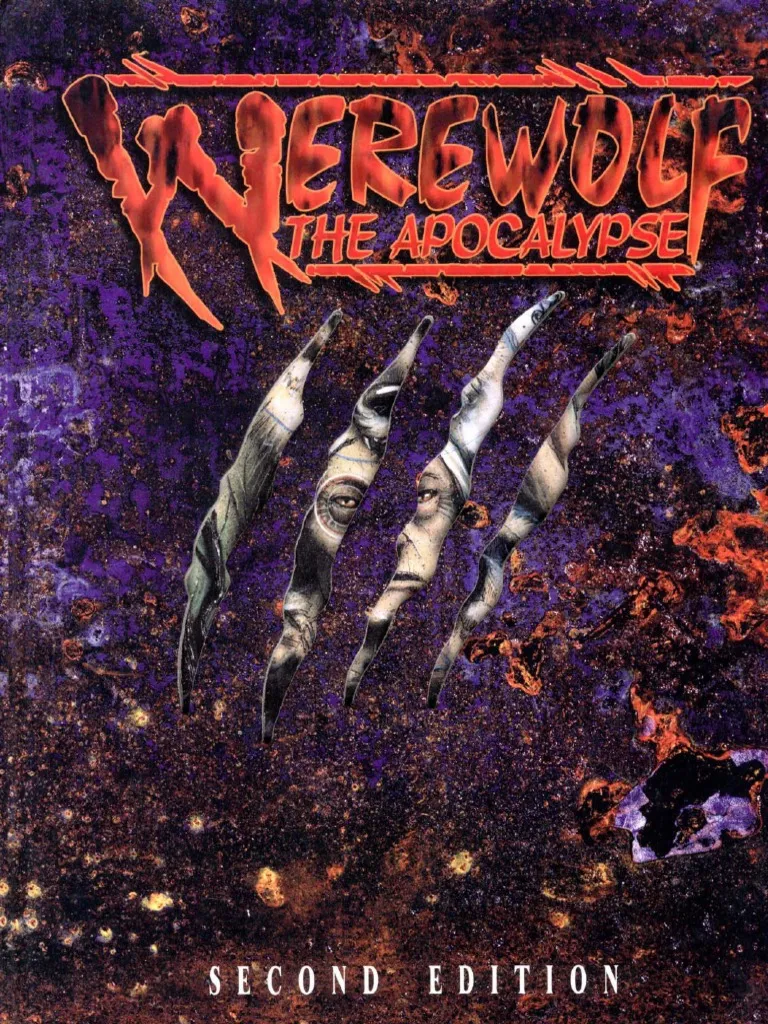
Werewolf the apocalypse 2e
Werewolf: The Apocalypse Second Edition is a tabletop roleplaying game set in the World of Darkness, a modern gothic horror universe where supernatural creatures exist in secret. Players take on the roles of Garou, werewolves who fight to protect the natural world from corruption and destruction caused by humans, spirits, and the Wyrm, the force of decay and chaos. One player acts as the Storyteller, controlling the world, spirits, enemies, and narrative consequences.
The game uses a dice pool system with ten-sided dice. When attempting an action, players roll a number of dice equal to the sum of an attribute and a skill. Each die that meets or exceeds a target number counts as a success, and the total number of successes determines the outcome. The system emphasizes roleplay, storytelling, and tactical combat, while giving players flexibility in how their characters use supernatural abilities.
A core theme of Werewolf: The Apocalypse is the struggle between rage and responsibility. Characters have a Rage score, representing their inner fury and connection to their wolf nature. While Rage enhances physical power, it can also lead to loss of control, moral compromise, or destructive consequences. Characters also maintain a Humanity or spiritual balance score, reflecting their connection to mortal morality and the spirit world.
Character creation focuses on choosing a tribe, auspice (birth phase of the moon), and breed (homeland or lineage), which shape abilities, spiritual outlook, and social roles. Characters can also gain Gifts, supernatural powers granted by spirits, and mutations that reflect their connection to the Garou’s mystical and primal heritage.
Combat is deadly and often fast-paced, reflecting the physicality of werewolves, but the game also heavily emphasizes investigation, social interaction, and spiritual conflict. Players are encouraged to explore the tension between their human and wolf natures, engage with environmental and supernatural threats, and participate in storytelling that highlights personal and societal struggles.
Compared to traditional fantasy roleplaying games, Werewolf: The Apocalypse Second Edition focuses on moral dilemmas, environmental themes, and personal horror. It balances tactical mechanics with narrative depth, making it suitable for groups that enjoy dark, character-driven stories with supernatural and ecological stakes.

Call of cthulhu
Call of Cthulhu is a tabletop roleplaying game set in a horror universe inspired by the works of H.P. Lovecraft. Players take on the roles of ordinary people—investigators, scholars, detectives, journalists—who confront incomprehensible cosmic horrors, ancient deities, and forbidden knowledge. One player acts as the Keeper, controlling the world, non-player characters, and the unfolding narrative.
The game uses a percentile dice system. Actions are resolved by rolling two ten-sided dice to generate a number between 1 and 100, which is compared against a character’s skill rating. A roll equal to or below the skill indicates success, while higher rolls indicate failure. The system emphasizes realistic consequences and uncertainty, rather than heroic success.
A central feature of Call of Cthulhu is the Sanity mechanic. Exposure to supernatural events, horrific creatures, or forbidden knowledge can damage a character’s sanity, causing temporary or permanent psychological effects. Sanity loss reflects the fragility of the human mind when confronted with cosmic truths and serves as both a narrative and mechanical driver of tension.
Character creation involves selecting occupation, attributes, and skills. Occupation defines the character’s background and skill proficiencies, such as librarian, archaeologist, or police officer. Investigators are generally vulnerable in combat, encouraging problem-solving, research, and strategic thinking rather than relying on brute force.
Combat is possible but usually dangerous, as characters are fragile compared to monsters and cultists. The emphasis is on investigation, exploration, and uncovering hidden truths. Mysteries, clues, and player choice drive the narrative, with horror often emerging from what is implied or unknown rather than directly confronted.
Compared to traditional fantasy roleplaying games, Call of Cthulhu focuses on tension, psychological horror, and investigative storytelling. It is less about tactical combat or character optimization and more about atmosphere, suspense, and moral and mental consequences, making it ideal for groups interested in mystery, horror, and suspenseful storytelling.
Fanaat RPG: Kerkers en Draken
Our very own designed RPG! Set in the medieval times battle, explore and dungeoncrwal your way trough. Note: it is in dutch.